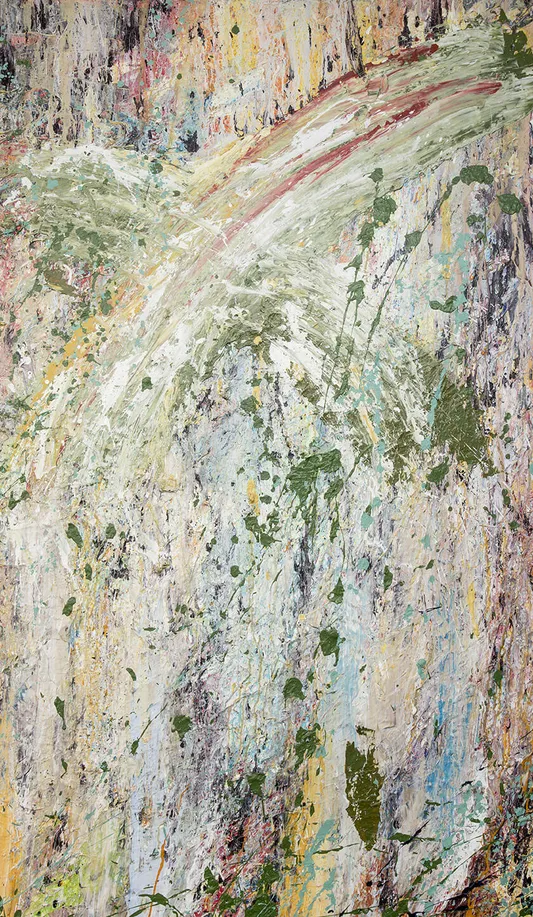
This section of the handbook expands on the earlier statement that Ainslie ‘spoke’ about painting by assembling artists and students and shaping the environment in which they worked.
From the early 1970s, Bill and Fieke Ainslie established a special tone and atmosphere wherever they lived and worked. They and their family lived in every one of the places that they occupied.
For example, the JAF itself was never closed or empty. People lived and worked there continuously. Ainslie moved perpetually from one area or zone to the other, as director, artist and inhabitant, and he attended drawing classes as a participant. Whatever he drew at that session was subject to commentary by teachers and students in the same ways as the drawings of everyone else in the group. He also invited individual students and teachers from time to time into his private studio for conversation or for responses to his current work.50
Hungry students could slip into the kitchen for a meal, and residential artists were accommodated in guest rooms. Artists would attend family meals as well as the dinners arranged for them to meet people of interest.
As an example of the access and openness which characterised the art foundation, this is what an artist, who worked both at home and at the art foundation, said:
Bill Ainslie was like a father figure … because you would just get a call: ‘What are you doing this Friday evening? Would you like to join us for dinner?’ you know, and then you’d go there and you’d find Bill was having this kind of night gathering of warm people, artists, actors, writers and so on and it’s like Bill’s house was like our homes were because we were welcome at any given time.
A key figure who kept the challenging and disparate activities in manageable shape was the Ainslies’ housekeeper for forty years, Ida Makoka. Those who visited the domestic areas never saw her sitting down. She catered cocktail parties for funders and diplomats, dinners for the Ainslies’ guests and lunches for speakers and their audiences; she met the needs of the Ainslie children and provided coffees and teas for all and sundry. She kept the reception area, entrance hall and living quarters in spotless condition. She also did the flower arrangements for the sitting and dining rooms.
This dedicated commitment to domestic tasks occurred within a particular context. Fieke Ainslie, the supervisor of enrolment, fees, venues and other organisational matters, made every building or house the Ainslies occupied appealing. The floors, walls, stairs and furnishings all emanated beauty and good taste. She managed this using minimal resources.52
Commenting in the 1980s on the combination of what Bill and Fieke Ainslie achieved in the house, artist Pat Mautloa said:
I don’t know if you have been very much to Bill’s house … when you enter there, there was this glow, this colour from the work and that tells you something about the person and you’d be able to sit there quietly and you’d be inside the atmosphere of colour which was very magical to me.
Similarly, Darius Brubeck once commented on the quiet and enhancing atmosphere he felt about the formality and elegance of the Saxonwold house’s entrance hall. He also commented on the degree to which Ainslie faced ‘trials’ by questioning ideas of the self, the essence of things, the nature of ancient knowledge and the processes of initiation.54
In addition to the entrance hall, the house in Saxonwold contained upstairs reception rooms, bedrooms and living rooms, bathrooms and a kitchen, as well as a studio for Ainslie. Spacious rooms downstairs were used for groups of part-time and full-time students to work in and gather for seminars, the ‘crit sessions’55 as well as for events such as musical performances and poetry readings. There was also a separate cottage for the housekeeper, Ida Makoka.
Outbuildings and a basement made etching and printing possible and there were spaces available for a writers’ group to meet and where new art works could be exhibited. There was also a double garage, which Ainslie used for painting his larger works against the walls, on the floor and, riskily, lying flat on the tarred driveway.
The garden offered opportunity for outdoor work, there was parking on the disused tennis court and there was a small swimming pool on the lawn. Sections of the grounds were used for sculpture and al fresco painting sessions.
In addition to Ainslie’s own work and teaching, multiple activities involved children, weekly painters, professional artists, teachers, visitors, academics and weavers. A range of practitioners such as sangomas as well as church groups were permitted to use the premises at specific times. Lunchtime seminars, debates and performances drew people from outside the foundation and took place on the spacious lawn. Businesspeople and professionals came after hours for individual opportunity to work with and speak to Ainslie.
The working areas were cluttered and crowded, difficult to heat, and hard work to keep clean. In other words, the whole space made possible a rich variety of activities but there was a spartan plainness in the working areas.
That tone and atmosphere made it possible for Dumi Mabaso, an artist who worked at various times at the art foundation, to describe that being there was ‘like another country, that whole building it was a country away from South Africa. We were in a different country’.56
Ainslie did not use the workshops only to enable individual artists to ‘become themselves’ and to push their work even further than they believed they could. He also used a process of mutual and interactive commentary on work done, at which he invited students and others present to comment on his work as well:
He would also ask you individually or as a group, ‘What do you think of this?’ and explain his problems with a particular painting. It was actually such a great thing that you could be on the same par with a master, or someone you look up to and he brought himself to your level and he said: ‘Listen, I’m just an artist like you and help me along as well.’ So there was that kind of feeding each other, a give-and-take situation, which I really enjoyed with Bill.
This is what it could be like to live in another country.
In the early 1960s, Mongane Wally Serote wrote of ‘the sweet smell of creativity’ that emanated from the house and studio in which Ainslie then lived in Parktown. Speaking after more than twenty years of exile, about what the JAF and other arts centres had been able to offer students, Serote remembered the sensation on entering an arts centre such as the JAF:
We saw … a space where we would be exposed to all kinds of knowledge … and … I’m conscious that we were breaking the law very deliberately in insisting on creating space for our thoughts, our spirit, for our being. The arts centre being that, when you entered the gate of the art centre it was like entering the most free space.
Ainslie’s workshops
At a conference in July 1979, Ainslie presented a paper on the importance of workshops for artists.59 The title of his paper was ‘An Artists’ Workshop – Flash in the Pan or a Brick that the Builders Rejected?’ Its focus was on the priorities of the workshops he assembled for the teaching component of his studio. He had been using workshops since the early 1970s and from the many forms which they could take, they had become an integral part of his teaching and learning.
Rather than focus on the practical details of his workshops, Ainslie argued at the conference that artists should turn away from the past, confront present realities and recognise that it is ‘the creative act which transfigures the past’. He argued that teachers should use workshop methods for discovering people’s creativity in the process of their encountering the exceptional, the unknown and the unexpected.
In stating that ‘I do not know how to make an artwork, and nor do I know how to teach people to do it,’ Ainslie added that for him, the ‘difficulty has to do with getting used to getting lost and working in the dark’. Furthermore, ‘teaching consists of leading, and being led, towards the threshold of the unconditional.’60
Ainslie gave concrete examples of the ways in which he encouraged and participated in the processes through which students went:
In the workshop we have people of all sorts, rich and poor, new and old, black and white, and it works. We watch people’s lives changing and thereby changing ours; everybody contributes. We don’t need ‘political’ art, or ‘relevant’ art, or ‘folk’ art, or ‘african’ art, or ‘suburban’ art or ‘township’ art – it’s all too self-conscious. What we need is to get on with the job of discovering ourselves, and let the labels be used by the ideologists. Beuys is right: all men are artists, they can all create their lives out of the raw material of their failed promises and defeated ambitions, because the promises that fail and ambitions that can be defeated are the raw stuff of the living stone. I like Joseph Beuys for giving me the idea that the workshop is a social sculpture.
Teaching at the Johannesburg Art Foundation
One way to understand the nature and zeitgeist of the JAF is to focus on the kind of teaching that occurred there and the tone that this established. Though busy, the centre itself was what Ainslie believed it should be, a secure, peaceful zone where it was possible to give extended attention to what mattered:
My studio is a place where people can work simply for the pleasure of it. Artworks and objects are not made for capital investment – you might as well put your head in a deep freeze. To learn properly, people must be fully engaged in what they are doing. And it is the teacher’s duty to keep them engaged … To learn, the students must see the point of an undertaking and what they stand to gain from it. We do not only have classes, but in order to back up the knowledge gained here, we also have discussions, symposiums, literature and films. People must be taught to appraise their own feeling and in order to do this must have a wider knowledge of what is going on around them.
My methods of teaching are based on the ideas and techniques of the French painter André Lhote and the American Hans Hofmann, both of whom also taught art … and consequently the projects set are based on these methods. I have taken what I find useful from them and used those ideas in conjunction with my own methods that I have evolved.
When asked about what he got from the environment of Ainslie’s studios, David Koloane replied:
The environment nurtured my confidence. I didn’t get a sense that anything was wrong. If I did something, we took it from there and explored that avenue. Bill provided me with technical advice as well as encouragement which stimulated my need to experiment. I had never come from a direction where I was taught at school that this was right or that was wrong. I had been working on my own, so I found this new direction challenging and not intimidating. The real development was that my work grew in strength and conviction.
Koloane’s account points to the pivotal nature of the workshops, which permitted a high degree of individual as well as collective focus. According to Ainslie’s handwritten notes, he argued that the status of teachers and students in the workshop should depend on the quality and value of what was said, and that the authority of what was said should arise from insight rather than from the personality of the teacher. What he wanted to achieve was an enabling process of initiation for would-be artists as they experienced their transformation rather than as talented people who merely acquired skills, techniques and know-how.
By rejecting White, middle-class, racial and institutionalised orthodoxies, Ainslie sought to make possible the joy of open and free communal creative work where ‘true relations between the unconditioned and the conditioned in art and in life’ could emerge.70
In response to the view that Ainslie discouraged the inclination of younger artists to make ‘township art’, Sam Nhlengethwa declared, ‘It was like a massive experiment with freedom. None of the artists lost their own style. It taught us something new.’71
David Koloane answered the question, ‘What was Bill like as a teacher?’ in this way:
I think he was committed as a teacher and very unique in that he had time for everybody. You know, he had the patience, he had the time, he never gave up on a student or gave up on anybody. He would actually make you realise that what you thought were mistakes were actually your strong points so that in that way he changed the perception that there was something wrong. He would say this is the right way to do it, why don’t you carry on doing this and out of that would come something that would actually surprise you and say that is that. What you thought was a weakness was actually a strong point, a strong character of yourself in you.
Commenting on the influence on students and artists of the JAF, former Council member Cyril Manganye said:
If you look at the works of the late Mandla Nkosi and Sam Nhlengethwa, those are the students that he encouraged to become themselves – he encouraged them to get their own research. He used to encourage them to develop on that line … It was not just stereotype teaching. He said find your line, find your artist, find your mentor and see if you can understudy them and find something out of them.
As mentioned earlier, seminars, lectures, debates and discussions were a vital part of the experience for both students and artists. It was this breadth and variety to the foundation’s nature that Serote understood was so necessary for South Africans to experience if they were to be active members and creators of a post-apartheid society. This moved Serote in 1982 to urge Ainslie and others to establish arts centres throughout the country, which would expose township and rural people to a rich diversity of creative possibilities.
Workshops: some examples
The first example is from 1973, when Ainslie was teaching in the former Yugoslav Embassy house in Killarney. Classes were held in three downstairs rooms. Ainslie taught six classes a week, each lasting about two hours. He usually had six to eight students in a class. They paid him R20 a month for one lesson a week. According to Geoffrey Lawrence:
His classes are a mixed bag. A couple of teenagers, an art student from Wits taking extra lessons, a businessman or two, and maybe a housewife. He’s taught successful professionals like Harold Voight, Lucky Sibiya and Sydney Kumalo. He’s also taught a member of the Prime Minister’s Economic Advisory Council, a former SA judo champion, a psychotherapist, an engineer, two headmasters and a number of surgeons and company directors.
Writing in 1977, Peter Anderson described what was called a ‘crit session’ of a student painting, held in the teaching studio at 61 Oxford Road, Saxonwold:
On the day I attended, the painting in question was abstract – broad areas of colour done in enamel paint, hard and glossy. Green spread across the lower half; a sharp-edged grey square dominated it higher up. A wedge of flesh pink, tipped with red, caught my eye: also some patches of dark blue. ‘Let me formulate my responses,’ said Ainslie, inclining his head. ‘When I first saw this painting I responded to the green area as a field, a landscape. But this – this pink area – is pinched – like hurt flesh. At the moment, however, I am not certain of the blues …’
At this level, and at progressively rigorous levels, the discussion was pursued, while Jill, the student whose painting it was, sat quietly and intently listening. Various approaches to the painting were considered: the historical, the analytical, the naïve. Ainslie challenged his students to ‘see the painting for what it is’.
‘I think what we are doing here is an initiation, rather than an education,’ Ainslie remarked. ‘Nobody can make a work of art out of deliberate intent. All he can do is make himself deserving of it.’75
The people drawn to this centre were freely admitted, without consideration of institutional or apartheid-based criteria. Therefore, Ainslie could orchestrate the following combinations of experience for artists and students:
In keeping with the modern movement, the teaching is not academic in the sense of stressing technical skill and reproducing conventional art models. Instead the Art Foundation promotes the workshop concept, emphasising the importance of the example of the master, the immersion in the tradition, the significance of the individual vision, and the challenge of the new. Exposure to the best artists and the greatest examples of art work is an essential part of the process.
The following are comments by artists who attended classes and workshops under Ainslie’s guidance.
Ainslie’s daughter, Sophia, has become a notable artist who works and teaches in Boston, US. She described her experience of being taught as follows:
I have been in and out of Bill’s classes and the art foundation workshops all my life … Over and over I went through carefully structured still life and drawing classes … They were thoughtfully designed exercises developed to open our eyes to the act of seeing – to acutely observe the unique moment in front of you … At age 12, I remember focusing on a still life of onions for six weeks. One frustration I had with Bill’s teaching in my late teens and early twenties was he very rarely, if ever, gave me answers to my questions … A characteristic that I admired was his ability to be completely honest with his critique without the need to fluff it up or sugar coat it. He very seldom praised work. In fact, I don’t think I remember a time that he did. There was always more to be done. More questions, more thinking, more work. I feel this taught me to trust myself and my decision making.
William Kentridge has become an internationally recognised artist in many fields. He has said, ‘in some ways Bill was a terrible teacher … providing no practical, basic guidance or instruction’. Kentridge did say that good teaching of drawing of a formal, conservative and academic kind occurred there. Though it was not a good school through which to learn a skill or a craft, it was a good place to generate an enquiring mind and spirit. He added, ‘I get caught in the dichotomy between it being a really great school and a really bad school and I think it was both.’78
Anthousa Sotiriades was a medical student who was taught art by Ainslie, and, in turn, taught at the JAF and the Alexandra Arts Centre in the 1980s. She acted as director of the JAF and has subsequently led the art department at the National School of the Arts in Johannesburg. In her multiple interviews about the foundation, she mentioned how Ainslie allowed everyone to express a view. For her, the emphasis was more upon perception than conceptual thinking, and there was continuous encouragement to search for new ways to express things and to make one’s voice heard.79
Sam Nhlengethwa has become an artist recognised for his work in a number of countries. He is prolific and industrious, and found his artistic feet by associating with Ainslie and the JAF. He described his experience:
Well in one of the things I discovered about somebody who loved jazz is that there is a period when people break away and do some free form of jazz. That’s exactly how I can describe Bill because Bill had this thing of taking a canvas and playing with the colours … So exactly he taught us many things, how to use this medium – gel and acrylic mix them together and getting certain textures, playing with them. Don’t try to be formal and stiff on the canvas, just play it, just create, just let the inspiration pour out of you.
Interviewed about his thoughts on Ainslie the artist and the centre he had established, William Kentridge made two interesting observations. The first was about the wretched disputes in the South African political and art worlds over abstract and figurative painting:
So you had this interesting phenomenon of someone who on the one hand was a very clearly politically engaged figure and wasn’t taking to abstraction as a way of avoiding politics and was making a very strong argument for the possibility of both things to exist. To be a politically engaged person didn’t mean you had to be involved in figurative painting and if you were involved in figurative painting it wasn’t enough to say ‘Oh, because I had a political connection.’ It had to be able to function at the same level formally as the most advanced abstract painting.
Making abstraction the benchmark against which the quality of figurative painting is measured is a real turnaround.
Kentridge’s second observation highlights the less didactic but vital dimension of the activities of the art foundation:
And I think that the vital things that Ainslie did socially was having meetings at his house, gatherings at his house, the evenings that Fieke was largely responsible for where there would be meetings of different people who wouldn’t otherwise meet in Johannesburg society at all. I mean that there was an extraordinary sense of style that she gave to his house and to those evenings and lunches.
Mining magnates, diplomats, township- and city-based artists, theatre people, writers and teachers, critics and journalists, musicians and businesspeople such as the politically active owner of a butchery in Alexandra township as well as political figures of all progressive shades mixed and mingled on these occasions in a warm ambiance of rooms with large Ainslie canvases on the walls.
At gatherings at the foundation, one could meet a range of people who were seriously engaged in what they did and did well. It was Fieke who brought that community together. Bill Ainslie went beyond the foundation into gatherings with communities and organisations, usually in tandem with David Koloane, to implement their combined ways of meeting the needs of artists.
Notes
It was one of Ainslie’s tenets that learners needed to learn and develop in the same places where established, working artists were busy.
Sam Nhlengethwa, interviewed by Simon Trappler, Johannesburg Art Foundation papers, unpublished, 2007.
There is the view that this level of décor and entertainment could not have been achieved without substantial funds. It is the author’s opinion that they made much from little.
Pat Mautloa, interviewed by Simon Trappler, 2007.
Darius Brubeck, personal observation to Michael Gardiner, 1 November 2012.
After each painting and drawing session, participants and the teaching staff discussed the work that had been done.
Dumisani Mabaso, interviewed together with Cyril Manganye by Elizabeth Castle, Soweto, 12 February 2012, p. 13.
Dumisani Mabaso, interviewed by Elizabeth Castle, Soweto, 12 February 2012.
Mongane Serote, interviewed by Elizabeth Castle, Johannesburg 2013.
The State of Art in South Africa conference was held at the University of Cape Town, 16–20 July 1979.
Ainslie, ‘An Artists’ Workshop’, 1979 UCT Conference, p. 84.
That stone overlooked by builders has a special value.
Joseph Beuys (1921–1986) was a German artist who included debate, discussion and teaching in his definition of art.
Ainslie, ‘An Artists’ Workshop’, 1979 UCT Conference, p. 87.
Bill Ainslie in Rosemary Smythe and Frances Rowsell, In the Interests of Art.
French Cubist painter André Lhote (1885–1962) developed notions of ‘screens’ and ‘passages’, describing the structuring and interconnection of pictorial planes.
German-American Hans Hofmann (1880–1966) articulated the theory of ‘push and pull’, describing the dynamic tensions of colour, form and spatial depth.
Rosemary Smythe and Frances Rowsell, In the Interests of Art.
David Koloane, interviewed by Vanessa Anderson, ‘The Use of Abstraction’, Technikon Natal, 1999, vol. II, p. 157.
The estimation of ‘quality and value’ of what teachers offered belonged to the students.
In the introduction to his book, The Way of the Sufi (London: Jonathan Cape, 1968), Idries Shah begins with the following epigraph from Nuri Mojudi: ‘The Sufi is one who does what others do – when it is necessary. He is also one who does what others cannot do – when it is indicated.’
J. Brooks Spector, ‘South Africans Get Ready for the Venice Biennale 2013’, Daily Maverick, 27 May 2013, p. 5.
David Koloane, interviewed by Simon Trappler, 2011, p. 3.
Cyril Manganye, interviewed together with Dumisani Mabaso by Elizabeth Castle, 12 February 2012.
Geoffrey Lawrence, ‘Bill Ainslie: Teaching Society to Paint’, Signature, 1973, p. 26.
Peter Anderson, ‘Portrait of a Studio’, To the Point, 11 March 1977, p. 35.
Bill Ainslie, quoted by Sophia Ainslie, ‘The Voice of the Nation’, in Gary van Wyk (ed.), Decade of Democracy (Boston: Sondela, 2004).
Sophia Ainslie, an essay for Elizabeth Castle’s MAFA research, 21 June 2014.
William Kentridge, interviewed by Simon Trappler and Elizabeth Castle in 2013 and 2014 respectively.
Anthousa Sotiriades, interviewed in 2011, 2013 and 2016 by Simon Trappler, Elizabeth Castle and Michael Gardiner respectively.
Sam Nhlengethwa, interviewed by Simon Trappler, 2007.
William Kentridge, interviewed by Simon Trappler, 2007.
William Kentridge, interviewed by Simon Trappler, 2007.