As a political and social being, Ainslie was perpetually engaged in activities in the public realm. His articles in The Bulawayo Chronicle are quoted in the section Ainslie speaks about art and his famous letter to four colleagues in 1965 is referenced in more than one place in this handbook.
Ainslie never regarded what he did at his studio or, later, at the art foundation as exclusively private. One view of him is that he was constantly acting and thinking within a network of instances and possibilities. Another way to see the nature and extent of his public activities would be to draw a spider map with the JAF at the centre, with links radiating out in all directions and at multiple levels with arts centres in Soweto, Katlehong, Alexandra township and the city centre, as well as in towns and places elsewhere.
It is remarkable how figures like Ainslie, who were in Johannesburg and concerned with the arts, sustained their activities by establishing extensive networks. Notably, there was Barney Simon, theatre director and co-founder of Johannesburg’s Market Theatre, which, through its Laboratory, brought in drama groups for performance and training from villages and towns across the country. Then there was Lionel Abrahams with his literary magazines and writers’ groups. There were publishers such as Ravan Press, with key contributions from editors Mike Kirkwood and Mothobi Mutloatse, who not only produced publications that revisioned history but also put out a radically different magazine, Staffrider, and held massive poetry readings on the edge of the city on Saturdays. Public activity of this kind was normal in the 1960s and ‘70s and beyond.
David Koloane’s appointment as the first Black artist to run an art gallery coincided with a wider surge in Black-led cultural initiatives, including the magazine New Classic and the Federated Union of Black Artists (FUBA), both under the leadership of Sipho Sepamla. Ainslie and Koloane were instrumental in supporting their formation.
The Culture and Resistance Symposium
The ANC’s initiative in 1982 to bring South Africans inside and outside the country together in Gaborone to celebrate and discuss possibilities for the incorporation of cultural initiatives into the ‘struggle’ for liberation from apartheid generated excitement and expectation among exiles and ‘insiders’. However, the ANC’s lack of a cultural vision or policy, plus the lack of acknowledgement of what was already happening inside the country, meant that the conference leadership had little to offer other than slogans such as ‘culture is a weapon of struggle’ and that everyone was a ‘cultural worker’. These postures did not sit well with most participants, who themselves were divided on whether the realities of apartheid should focus on questions of ‘race’ or ‘class’.
Because the Gaborone festival achieved so little, the ANC moved to establish a Department of Arts and Culture in 1983. Then, in 1987, it held a Culture in Another South Africa conference in Amsterdam, which passed a series of rigid policy resolutions by a selected range of delegates.83
Ainslie and Koloane played a number of roles for the symposium in Botswana, most notably in putting together with Dikobe wa Mogale Ben Martins, Emile Maurice, Colin Smuts, Paul Weinberg and Gordon Metz an ‘Art Towards Social Development’ exhibition of 169 works by 58 artists.
At the end of the 1980s, once it became clear that the ANC’s hard line on culture was counterproductive, ANC intellectual and future Constitutional Court judge Albie Sachs questioned the ANC’s stance on cultural matters. Sachs called for the intrinsic dispositions of art to be set free, proposed a moratorium of five years on ANC members saying that ‘culture is a weapon of struggle’, and argued that a ‘purely instrumental and non-dialectic view of culture was damaging not only to art, but also to the struggle itself.’84
During the symposium at the Festival, Mongane Wally Serote met with Nadine Gordimer, David Koloane, Bill Ainslie, David Goldblatt and Bongi Dhlomo to discuss possibilities for the establishment of a network of arts centres in South Africa, using the JAF as a conceptual starting point. The intention was that township and rural people could experience the range and variety of activities that the arts make possible, thereby giving the arts a role in the preparation of people for participation in a democratic society.
Both Ainslie and Koloane had already contributed to the work and existence of FUBA, the Katlehong Arts Centre, Funda Community College in Soweto and other community-based initiatives.
Important as his suggestion was, Serote at that time was living in exile, working for the ANC’s Department of Arts and Culture in London. He asked for something that only an outsider to the country could ask. Though a number of long-established township cultural centres were able to continue their activities during what was essentially a civil war at that time, attempts by people, who were not well known and trusted, to ‘parachute’ into communities to do good were met with hostility and suspicion.
Nevertheless, on his return to South Africa from Botswana, Ainslie set about establishing the kind of centre that had been discussed. The first of these enterprises was to develop, with the co-operation of Joe Manana, a friend of Serote and township butcher, into the Alexandra Arts Centre (AAC) in 1986 with a local director, Bongi Dhlomo, and a range of teachers and instructors from the JAF, the Alexandra community and elsewhere.
Unfortunately, the AAC became a battleground between rival township factions, a situation complicated by questionable interventions by police, with the consequence that Dhlomo had to withdraw after being accused of various unproven improprieties, thus facing risk to herself and her family. When he went into Alexandra to inform students of the change, Ainslie had to deflect the threat of his being killed by unruly individuals. The next director, James Mathoba, was hijacked and shot while driving the centre kombi, and the staff found it increasingly difficult to teach. The centre closed in 1992.85 David Koloane played no part in this enterprise.
Thupelo Artists’ Workshops
When Sir Anthony Caro spoke about art at a public lecture in Johannesburg in 1981, Ainslie pointed out to him that his audience was predominantly White. Ainslie and Koloane gave Caro an opportunity to see what the situation of Black artists was, and in response he opened attendance at the Triangle Artists’ Workshops in upstate New York to South Africans. He also used his stature in the Western art world to assemble a collection of over 100 artworks from notable artists such as Henry Moore for FUBA to use for fundraising and art education.
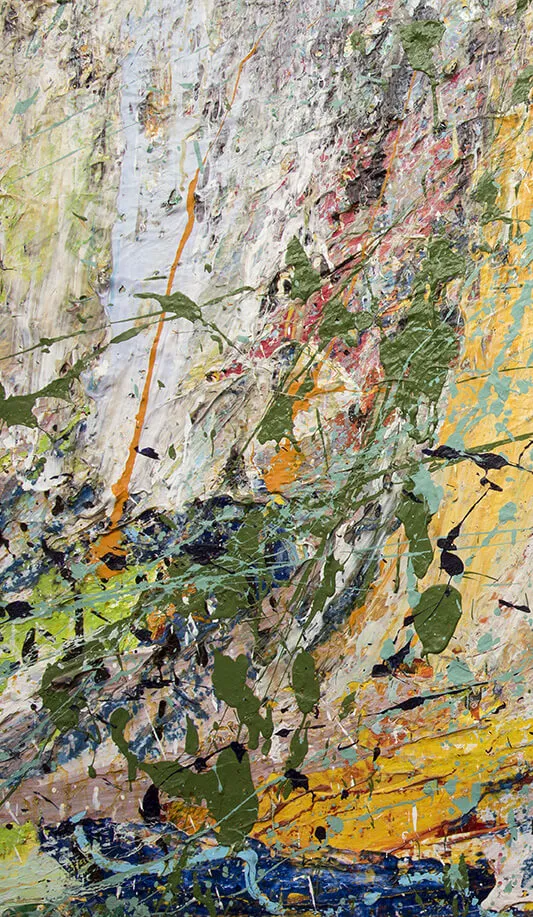
Soon both Koloane and Ainslie attended the Triangle annual events and, with their knowledge of the situation at home, and their experience of Triangle workshops in upstate New York, Koloane and Ainslie developed the idea of workshops in which local artists, especially those with limited means, could meet, reflect and try out different ways of making art. The first such workshop took place in August 1985. Quantities of materials such as paint and canvas with a range of implements were freely available. There was no teaching but there were opportunities for work, thought and discussion. Many of the artists experimented for the first time with making non-representative, abstract works and everyone enlarged their scale immensely since there were space, time and materials in abundance.
Thupelo workshops were experienced in this way by an American academic:
For two weeks they worked non-stop, making large-scale paintings and mixed-media work, and experimenting with sculptural forms constructed from found materials. They paused only for meals and for critique sessions led by Bill Ainslie from the Johannesburg Art Foundation and Peter Bradley, a visiting artist from the United States … The intention of the project … was to create a temporary respite for black artists who lived in isolation from other artists, had limited access to the kinds of art facilities available to white artists, and worked in a representational mode on a limited scale … The … workshop was an eye-opening adventure, one that altered the direction of black artists’ work in subsequent years.
In contrast, there was the hostility towards the Thupelo project from academics, critics and gallery owners, based upon what they saw as an emphasis on Ainslie’s using his interest in abstraction to influence Black artists. There was also hostility from within post-school art-teaching institutions about the nature of the art foundation. Critics, for example, glibly assumed that abstraction meant eliding political issues; the gallerists showed their commercial and sometimes racial motives by demanding that Black painters use particular styles.
At bottom, there was a real desire to attack Bill Ainslie, and this can be read as an unwillingness by the ‘establishment’ to acknowledge that an essential dimension of being an artist is to be free from the compulsions of commerce and formal courses and assessments. Their response to how Ainslie and the JAF made possible the emergence of coherent creativity was clearly a fear of freedom.
Though he did not enter the controversy over Thupelo at the time, Ainslie wrote this:
In the end no method or ‘school of thought’ was offered. This constituted the major challenge of the work, a challenge which stimulated workshop participants but caused serious problems for some artists who attended the subsequent exhibition. It is likely to constitute a watershed between those artists who seek a justification for their work from some external orthodoxy, whether it be figuration or political comment or some derivation from African traditional iconography to provide the credentials for ‘African identity’, and those who welcome the opportunities for opening new possibilities made available by modernism through the elimination of redundant and inhibitory concepts. The recurring spectre of modernism – the issue of order or chaos – and the apprehensive casting around for some objective correlate haunted observers more than the participants for whom the issue was dealt with practically with the work situation and not theoretically.
Once much of the dust of the dispute had settled, Kathryn Smith said this:
The Thupelo workshops of the mid- to late-1980s, which promoted an abstract expressionist language as a counterpoint to the didacticism of resistance art (which has been the subject of vigorous critical debate), can be considered as another space of experimentation, at least insofar as they gave black artists the luxury to experiment in focused workshop situations and interact with their contemporaries from elsewhere in the world. During a period of intense cultural isolation, the importance of this cannot be overlooked, as it extended the professional and creative potential of predominantly black artists beyond FUBA and Funda. As part of the international Triangle Project, Thupelo gave rise to spaces like the Bag Factory in Johannesburg and, later, Greatmore Studios in Cape Town.
In fact, the Triangle/Thupelo artists’ workshop idea implemented in Africa meant that, by 2005, 1 400 African artists had attended such workshops. Since then, under the co-ordination of Gasworks,89 there have been artists’ workshops in the Middle East, Latin America and the Caribbean, South Asia, New York, the Indian subcontinent and elsewhere.
Notes
Willem Campschreur and Joost Divendal (eds), Culture in Another South Africa (London: Zed Books, 1989).
Stephen Clingman, ‘Writing the interregnum: literature and the demise of apartheid’, in David Attwell and Derek Attridge (eds), The Cambridge History of South African Literature (Cambridge: Cambridge University Press, 2012), p. 645.
For a description of the atmosphere inside Alexandra township from February 1986 onwards, see William Dicey, 1986 (Cape Town: Umuzi/Penguin Random House, 2021), pp. 40–43.
John Peffer, Art at the End of Apartheid (Minneapolis and London: University of Minnesota Press, 2009), p. 131.
Draft introduction to the first Thupelo workshop exhibition, titled ‘Bill Ainslee’ (sic). Typed, with handwritten emendations, undated, Johannesburg Art Foundation papers.
Kathryn Smith, ‘The Experimental Turn in the Visual Arts’, in Thembinkosi Goniwe et al. (eds), Visual Century, vol. 4 (Johannesburg: Wits University Press, 2011), p. 131.
Gasworks, a centre for international artists’ residencies in London, founded in 1994 by Robert Loder, has become the main hub of the Triangle network.